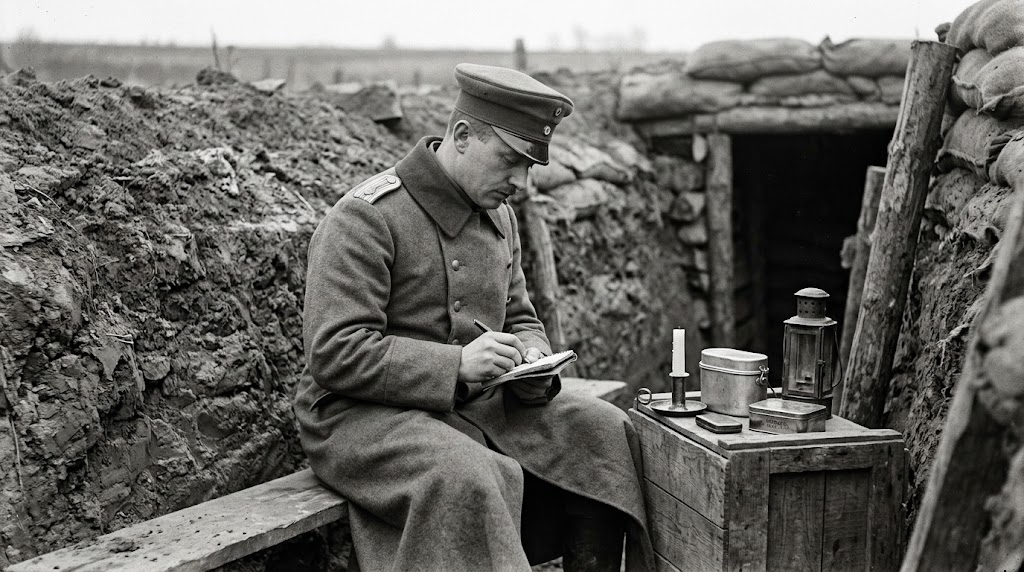
While British provincial newspapers preserved hundreds of frontline letters in January 1915, firsthand German diaries written during the ceasefire itself remain far rarer. Among the most detailed primary records ever recovered from the German side of No Man’s Land is the wartime notebook of Lieutenant Kurt Zehmisch of the 134th Royal Saxon Infantry Regiment. Recorded in shorthand during December 1914 in the trenches facing Frelinghien and Ploegsteert Wood, Kurt Zehmisch’s 1914 Christmas Truce diary provides an immediate, unedited account of how Saxon and British soldiers turned a frozen battlefield into an impromptu space of peace.
Who Was Lieutenant Kurt Zehmisch?
Before the outbreak of the First World War in August 1914, Kurt Zehmisch worked as a secondary schoolteacher in Saxony. Educated in modern languages, he spoke fluent English and French—a skill that proved decisive when opposing trenches fell silent in December 1914. Mobilized as a reserve officer in the 134th Royal Saxon Infantry Regiment (part of the XIX Saxon Army Corps), Zehmisch served on the Western Front through the autumn campaigns in northern France and southern Belgium.
By mid-December 1914, Zehmisch’s company held waterlogged sandbagged breastworks along the River Lys valley opposite Frelinghien and the southern edge of Ploegsteert Wood. Facing them across narrow strips of shell-pocked farmland stood British battalions including the 2nd Argyll and Sutherland Highlanders, the 1st Royal Welch Fusiliers, and the 1st Battalion, Hertfordshire Regiment.
Because Zehmisch maintained a private daily notebook written in German Gabelsberger shorthand rather than relying solely on official regimental reports, he recorded candid human interactions that senior Prussian and Imperial staff officers preferred to omit from formal histories.
What Kurt Zehmisch Recorded on Christmas Eve and Christmas Day 1914
Zehmisch’s entries from 24 to 26 December 1914 trace the exact sequence of events along the Saxon frontage—corroborating British regimental accounts down to weather changes, whistle signals, and shared burial duties:
- 24 December 1914 (Lighting the Trench Parapets): After weeks of freezing rain, a sharp afternoon frost hardened the flooded clay. Zehmisch noted how Saxon soldiers placed small fir trees (Tannenbäume) illuminated with candles along their sandbag parapets at dusk, followed by carol singing and calls across the wire to British sentries.
- Whistling Across No Man’s Land: Zehmisch recorded that British troops initially responded with applause and counter-carols before soldiers on both sides began whistling familiar tunes back and forth across the darkness without a single rifle shot being fired.
- 25 December 1914 (Meeting Between the Lines): On Christmas morning, Zehmisch stepped into No Man’s Land and used his fluent English to converse directly with British officers and riflemen. He documented the open-air exchange of cigarettes, cigars, biscuits, tunic buttons, and family photographs, noting the complete absence of personal animosity between Saxon and British infantrymen.
- Joint Burial Truces and Informal Football: Alongside soldiers from the neighbouring Frelinghien sector, Zehmisch observed joint burial parties recovering unburied autumn casualties from the frozen ground and soldiers kicking a ball across the open meadows between the barbed wire.
“It was a wonderful, never-to-be-forgotten day. The English officers and men came out of their trenches, we went out of ours, and we shook hands and wished each other a Merry Christmas as if there were no war at all.”
To compare Zehmisch’s eyewitness testimony with contemporary accounts of the impromptu kickabouts in the same sector, examine our evidentiary review of the 1914 Christmas Truce football match.
The 1999 Rediscovery in a Leipzig Attic
For more than eighty years after the armistice of 1918, Kurt Zehmisch’s diary remained unknown to military historians. Following the war, Zehmisch returned to civilian teaching in Germany, and his wartime notebooks were stored inside a wooden trunk in his family’s attic in Leipzig, surviving both the Second World War and the decades of East German division.
In 1999, Zehmisch’s son discovered the shorthand notebooks while sorting through family papers and had the archaic Gabelsberger stenography transcribed into modern German. Because the entries had been written contemporaneously in the trench dugout—rather than reconstructed decades later from memory—historians immediately recognized the diary as one of the most reliable primary sources confirming both the scale of the Anglo-Saxon fraternisation and the spontaneous football games near Frelinghien.
Corroborating Saxon and British Archives
Within the Operation Plum Pudding archive, German accounts such as Lieutenant Zehmisch’s diary are paired directly with British Expeditionary Force Battalion War Diaries (The National Archives, WO 95 series) and January 1915 county newspaper letters.
Cross-referencing Zehmisch’s shorthand notes against British dispatches from Ploegsteert Wood, Hampshire Regiment letters, and Cumbrian Border Regiment accounts demonstrates how remarkably consistent the frontline experience was across opposing trenches. Both British and Saxon infantrymen viewed the ceasefire not as mutiny, but as a brief, shared reclamation of civilian humanity before High Command orders forced the war to resume on Boxing Day.
Explore more firsthand correspondence in our Christmas Truce 1914 eyewitness letters archive or consult our chronological 1914 Christmas Truce overview.