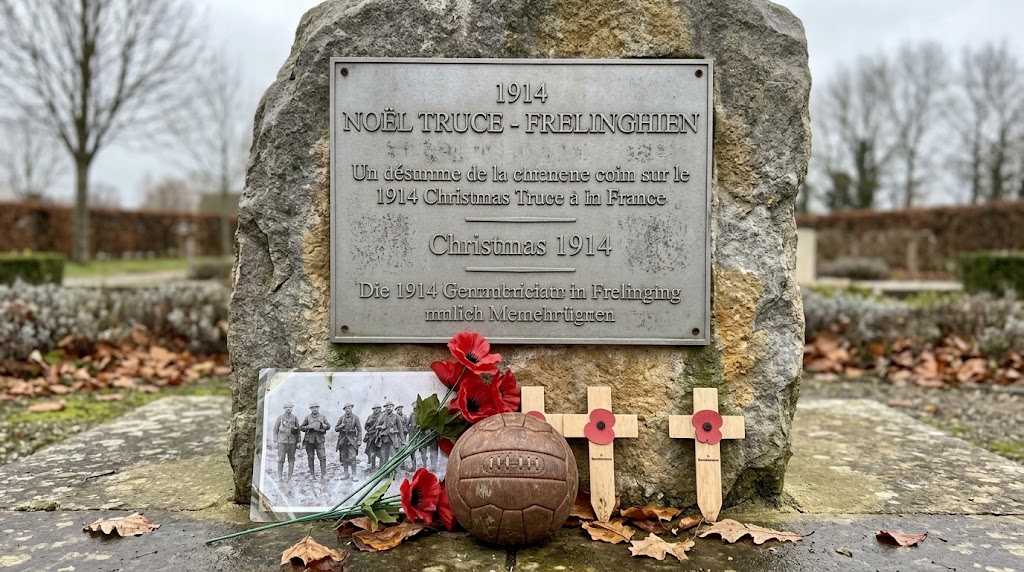
In the commune of Frelinghien, situated on the south bank of the River Lys just across the Belgian border in northern France, a permanent commemorative monument marks one of the most thoroughly documented sectors of the December 1914 ceasefire. The Frelinghien plaque 1914 Christmas Truce memorial honours the spontaneous armistice observed along the Armentières–Houplines–Frelinghien line, where infantrymen of the British Expeditionary Force (BEF) and the Royal Saxon Army stepped out of waterlogged trenches to sing carols, bury fallen comrades, exchange rations, and kick a football across frozen farmland.
Historical Context: The Frelinghien Sector in December 1914
Following the close of the First Battle of Ypres in November 1914, the front line stabilized through the flat agricultural fields between Armentières and Frelinghien. Because the River Lys valley sits just above sea level, high groundwater levels prevented deep trench excavation. Instead, opposing forces constructed raised sandbag breastworks separated by narrow strips of No Man’s Land ranging from fifty to one hundred and fifty yards wide.
By mid-December 1914, the British line opposite Frelinghien and neighbouring Houplines was held by battalions of the 19th Infantry Brigade—most notably the 2nd Battalion, Argyll and Sutherland Highlanders and the 1st Battalion, Royal Welch Fusiliers—alongside units of the 4th Division. Directly opposite them stood formations of the German XIX (2nd Royal Saxon) Corps, including the 133rd and 134th Royal Saxon Infantry Regiments.
Unlike Prussian guards units in other sectors, many Saxon infantrymen had worked in Britain prior to August 1914 and harboured little personal animosity toward British troops. When temperatures dropped sharply below freezing on the afternoon of 24 December 1914, turning flooded clay into solid ground, conditions were set for one of the longest and best-documented local ceasefires on the Western Front.
Primary-Source Evidence from Frelinghien and Houplines
The historical significance of the Frelinghien sector rests on rare, corroborating eyewitness records preserved in both British regimental archives and German field diaries:
- Lieutenant Johannes Niemann (133rd Royal Saxon Infantry Regiment): Stationed in the trenches facing Frelinghien, Niemann recorded in his field notes how British soldiers emerged on Christmas morning and how an impromptu kickabout developed on the frozen ground between the lines. His account provides specific tactical context regarding terrain conditions along the railway embankment and meadowland.
- Lieutenant Kurt Zehmisch (134th Royal Saxon Infantry Regiment): Positioned immediately adjacent to the Frelinghien–Le Touquet sector, Zehmisch documented the lighting of candle-lit fir trees (Tannenbäume) along the Saxon parapets on Christmas Eve and the subsequent fraternisation with British officers and riflemen.
- 2nd Battalion, Argyll and Sutherland Highlanders: Regimental war diaries and subsequent soldiers’ letters published in Scottish newspapers in January 1915 confirmed that hostilities ceased along the Frelinghien frontage from Christmas Eve until Boxing Day, allowing joint burial parties to inter bodies left unrecovered since autumn assaults.
Researchers examining the specific testimonies surrounding the informal kickabouts held in these meadows can explore our detailed evidentiary review of the 1914 Christmas Truce football match.
Unveiling the Commemorative Monument at Frelinghien
For decades after the First World War, no permanent physical marker identified the exact fields around Frelinghien where British and German infantrymen had met during Christmas week 1914. Local memory survived primarily through municipal archives, regimental histories, and cross-channel historical societies.
On 11 December 2008—marking the ninetieth anniversary of the end of the First World War—the town of Frelinghien, working alongside British, French, and German commemorative groups and European football representatives, unveiled an official memorial plaque and monument dedicated to the 1914 truce.
Key elements of the Frelinghien commemoration include:
-
Civic and International Dedication:
The ceremony brought together local French municipal officials, descendants of British and Saxon soldiers who served in the sector, and UEFA President Michel Platini, recognizing both the human solidarity of the ceasefire and the documented impromptu football games played in the parish.
-
Trilingual Historical Inscription:
The plaque records the events of December 1914 in French, English, and German, memorializing the soldiers of the British Expeditionary Force and the Saxon regiments who temporarily laid down their arms in the fields between Frelinghien and Houplines.
-
Preservation of Battlefield Geography:
Situated near the historic frontline corridor south of the River Lys, the monument anchors archival letters and regimental war diaries to the physical landscape, allowing visitors and school groups to understand the short distances separating opposing trenches.
Visiting the Frelinghien Memorial and Surrounding Truce Sites
Today, Frelinghien forms an essential stop along Western Front remembrance routes connecting Armentières, Houplines, Ploegsteert Wood (Plugstreet), and Ypres. Within a five-mile radius of the Frelinghien plaque lie several key archival locations from December 1914:
- Ploegsteert Wood (Belgium): Located roughly three miles north of Frelinghien, where the 5th Battalion, London Rifle Brigade and 1st Battalion, Hertfordshire Regiment fraternised with Saxon troops on 24–26 December 1914.
- Le Touquet Railway Crossing: The sector boundary where Captain C. I. Stockwell of the Royal Welch Fusiliers met Saxon officers to coordinate burial truces and formal ceasefire termination signals.
- Prowse Point and Berks Cemetery Extension: Commonwealth War Graves Commission cemeteries preserving the graves of British soldiers killed in the sector during late 1914, including casualties buried during the Christmas ceasefires.
To compare the Frelinghien sector timeline with adjacent brigades across Flanders, consult our 1914 Christmas Truce overview, or read the original censored and uncensored correspondence dispatched from these trenches in our Christmas Truce 1914 eyewitness letters archive.
More than a century after the guns fell silent along the River Lys, the Frelinghien plaque stands as a permanent civic testament to the frontline reality documented in the Operation Plum Pudding archive—ensuring that the ordinary soldiers who stepped across No Man’s Land in December 1914 remain anchored in verified historical memory.