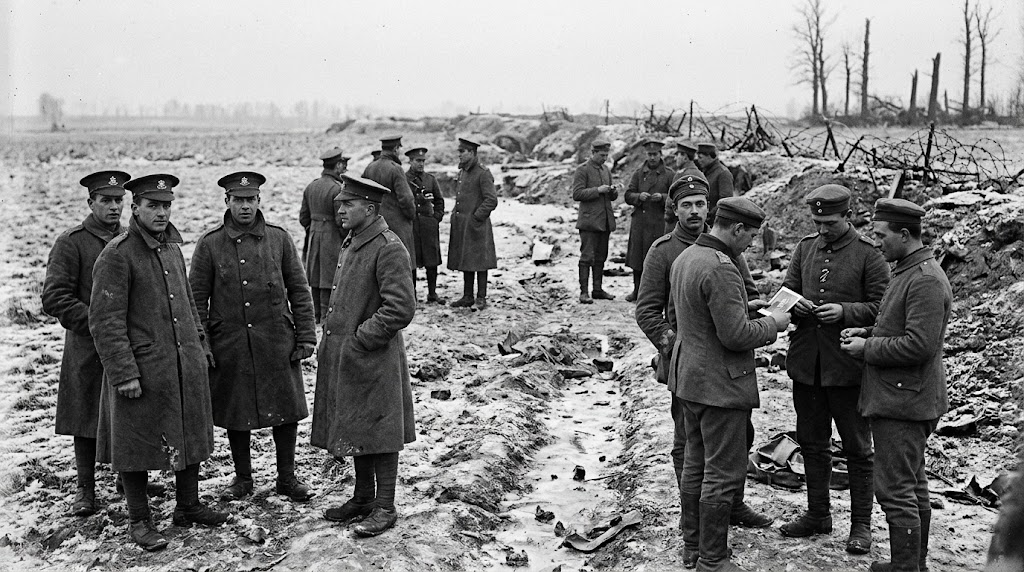
Among the many localized ceasefire accounts from December 1914, the letters printed in the Hampshire Chronicle on 26 December 1914 are of exceptional historical significance. Published on Boxing Day—while the unofficial truce was still active or only just ending—these dispatches escaped the sweeping, formalized military censorship that would be imposed on the provincial British press by early January 1915. Hand-written by soldiers of the 1st Battalion, Hampshire Regiment and related regional units, these invaluable accounts provide a raw, immediate window into the spontaneous peace that transformed No Man’s Land in the Ploegsteert Wood and Messines sectors of Flanders.
“Mingling with the Enemy”: The 1st Battalion, Hampshire Regiment at Ploegsteert Wood
By late December 1914, the 1st Battalion, Hampshire Regiment (part of the 11th Infantry Brigade, 4th Division) had endured weeks of relentless winter rains and bone-chilling cold in the low-lying trenches near Ploegsteert Wood and the Messines Ridge. The division’s frontline sat directly opposite Imperial German troops, including Saxon and Bavarian regiments, in some cases separated by less than eighty yards of shell-torn mud.
The severe frost that hardened the ground on Christmas Eve set the stage for an extraordinary transformation. Writing in letters swiftly sent back to Hampshire and published in the 26 December 1914 edition of the Hampshire Chronicle, frontline soldiers described the surreal, sudden end to the violence:
- The Sound of Music: Sentries and riflemen of the Hampshire Regiment recalled the German lines lighting up with small lantern-lit Christmas trees (Tannenbäume) and the sound of carols echoing across the freezing air, prompting the Hampshires to respond with their own songs.
- First Contact: At daybreak on Christmas Day, unarmed German soldiers appeared on their parapets, beckoning the British to meet them. After initial hesitation and officer negotiations, hundreds of Hampshire soldiers and their Saxon counterparts met in No Man’s Land to shake hands and converse.
- Trading Under Fire: The letters detail an eager, impromptu exchange of goods. The Hampshires traded their service caps, cap badges, and tins of bully beef, while German soldiers offered cigarettes, cigars, tunic buttons, and even pocket knives.
For more on the tactical environment of these neighboring units and their timelines, see our 1914 Christmas Truce overview.
The Raw Testimony: Transcriptions from the December 26, 1914 Edition
The immediate, uncensored nature of the Hampshire Chronicle letters makes them a goldmine for understanding the psychological reality of the truce. In one prominent letter, a soldier of the Hampshire Regiment described the scenes on Christmas Day:
“We are having a very quiet time just now, and on Christmas Day we had a truce. The Germans and our men met halfway between the trenches and swapped signatures, cigarettes, and all kinds of things. They even helped us bury some of our dead. It was the strangest Christmas I’ve ever had, and we were talking to them just like old friends, despite the fact we’d been shooting at each other the day before.”
Another account from the same Boxing Day issue highlighted the shared exhaustion of the soldiers, noting that many Germans expressed a deep longing for the war to end, showing family photographs and talking about their pre-war lives in England.
These early, unpolished accounts are invaluable for historians, offering a direct contrast to later, heavily sanitized wartime reports. You can explore a broader range of such direct correspondence in our eyewitness letters from the Western Front.
Archival Importance of the Hampshire Chronicle Records
What makes the Hampshire Chronicle accounts particularly precious to the Operation Plum Pudding archive is their publishing date of 26 December 1914. Because they were printed almost instantly, they were spared the retrospective “editorializing” or outright suppression that occurred in later weeks as the War Office tried to crack down on reports of fraternisation.
By comparing these letters to official military logs, such as the 1st Hampshire’s War Diary (WO 95/1496), researchers can verify the exact trenches where these interactions took place. The diary subtly notes the “very quiet” day with “no casualties,” which aligns perfectly with the vivid human encounters the men described in their personal mail.
This meticulous cross-referencing process is vital to ensuring that the history we pass down remains accurate and free from romanticized myth, as discussed in our study of the 1914 Christmas Truce football matches and our exploration of the Operation Plum Pudding project.
Legacy and Remembrance
Today, the historic letters of the Hampshire Regiment and their local coverage are preserved in regional archives and digital collections like ours, ensuring that the remarkable, brief peace of Ploegsteert Wood is never forgotten. These candid, unpolished voices remind us of the shared humanity that briefly broke through the darkest days of the First World War.