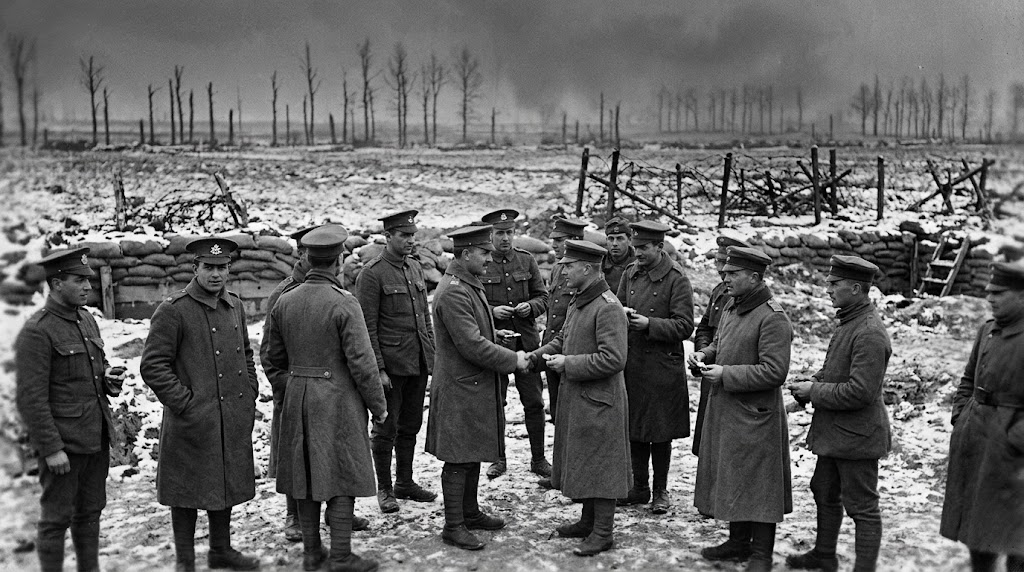
During the first fortnight of January 1915, regional newspapers across Cumberland and Westmorland—including the Cumberland News, the Carlisle Journal, and the Westmorland Gazette—published a remarkable series of frontline letters sent home by Cumbrian soldiers serving on the Western Front. Focused heavily on the experiences of the 2nd Battalion, Border Regiment near Rouges Bancs in northern France, the Cumbria 1914 Christmas Truce Border Regiment archive documents how troops from Carlisle, Kendal, Workington, and Whitehaven stepped out of waterlogged trenches on 25 December 1914 to bury fallen comrades, sing hymns, and exchange gifts with German infantrymen.
The 2nd Battalion, Border Regiment at Rouges Bancs in December 1914
In late December 1914, the 2nd Battalion, Border Regiment formed part of the 20th Infantry Brigade within the 7th Division of the British Expeditionary Force (BEF). Having suffered severe casualties during the First Battle of Ypres in October and November 1914, the battalion had rotated southwards into the low-lying agricultural sector around Rouges Bancs, situated between Armentières and Neuve-Chapelle.
Holding breastwork trenches alongside the 2nd Battalion, Scots Guards and the 1st Battalion, Grenadier Guards, the Cumbrian soldiers faced elements of the German VII Corps—specifically the 15th and 55th Westphalian Infantry Regiments. Separated by roughly eighty to one hundred yards of shell-pocked farmland, both sides had endured weeks of freezing rain, flooded dugouts, and relentless sniper fire prior to the sudden hard frost that arrived on Christmas Eve.
When German troops placed lit candles and small fir trees along their sandbagged parapets on the night of 24 December, men of the Border Regiment responded with traditional English carols. By morning, unarmed soldiers from both trenches climbed into No Man’s Land, initiating an informal armistice that lasted through Christmas Day.
Eyewitness Testimony in Cumbrian Provincial Newspapers
Because provincial editors in Carlisle and Kendal printed soldiers’ correspondence forwarded by local families before War Office press restrictions curtailed truce coverage, Cumbrian newspaper files preserved vivid, unvarnished accounts of the Rouges Bancs ceasefire:
- Joint Burial Services in No Man’s Land: Unlike sectors further north where informal kickabouts dominated memories, Cumbrian letters from Rouges Bancs emphasized the solemn recovery of bodies trapped between the barbed wire since autumn. British and Westphalian soldiers worked side by side with entrenching tools to dig graves in the frozen clay, holding a shared funeral service led by army chaplains and officers.
- Exchanging Rations and Souvenirs: Soldiers from Cumberland and Westmorland described trading British bully beef, Plum and Apple jam, Woodbine cigarettes, and brass cap badges for German cigars, rye bread, spiked helmet emblems, and tunic buttons.
- Conversations Across the Wire: Several Cumbrian accounts noted meeting German infantrymen who spoke fluent English from pre-war employment in London and northern England, expressing mutual exhaustion with trench conditions and surprise at how quickly wartime hostility vanished face to face.
To compare these Cumbrian dispatches with letters printed in southern county newspapers during the same week, examine our Hampshire Chronicle 1914 Christmas Truce letters and our broader collection of Christmas Truce 1914 eyewitness letters.
Corroborating Cumbrian Letters Against Battalion War Diaries
Within the Operation Plum Pudding archive, regional newspaper printings from Cumbria are cross-referenced directly against official military logs preserved at The National Archives in Kew—specifically the 2nd Battalion, Border Regiment War Diary (WO 95/1661) and the 20th Brigade Headquarters diary.
Although battalion adjutants avoided recording detailed descriptions of fraternisation to shield commanding officers from disciplinary reprimands by General Sir Horace Smith-Dorrien and British General Headquarters (GHQ), the war diaries confirm the exact map grid coordinates at Rouges Bancs, the sharp overnight freeze of 24–25 December, the cessation of sniping, and the formal warning orders issued on 26 December prohibiting further communication with the enemy.
Preserving Regional Memory from Cumberland and Westmorland
Following the termination of the ceasefire on Boxing Day, the 2nd Battalion, Border Regiment remained in the Rouges Bancs and Neuve-Chapelle sector into the spring of 1915, sustaining heavy losses during the Battle of Neuve-Chapelle in March 1915. Many of the Cumbrian infantrymen who shook hands with Westphalian soldiers on Christmas Day 1914 did not survive the campaigns of 1915 and 1916.
By preserving the January 1915 newspaper printings alongside official regimental records, the Cumbria archive ensures that the personal voices of Border Regiment soldiers remain anchored in verifiable historical evidence—forming an essential chapter of our 1914 Christmas Truce overview.