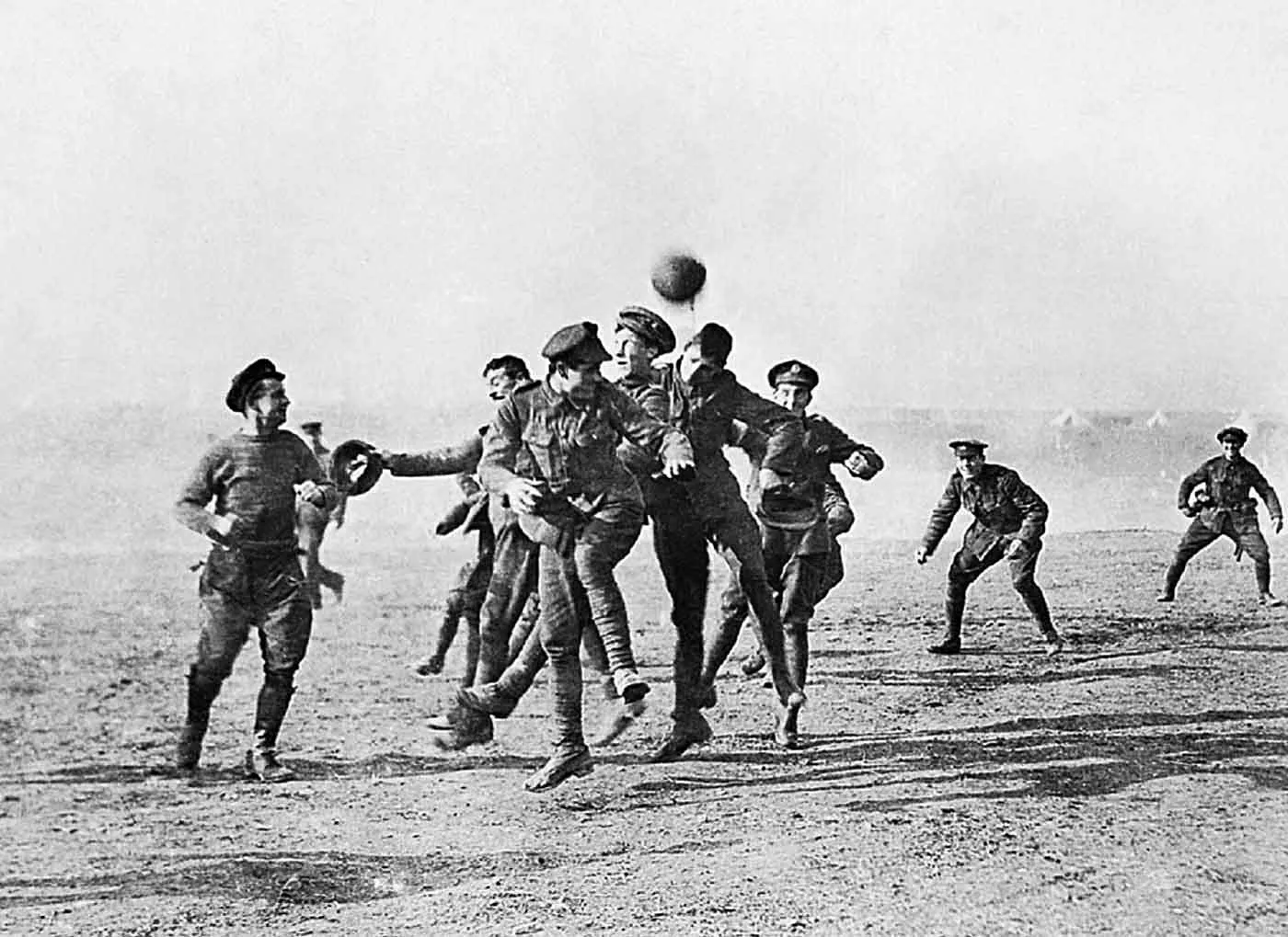
At 08:30 on the morning of 25 December 1914, following a sharp overnight frost that hardened the waterlogged mud along the river Lys, elements of the British Expeditionary Force (BEF) observed small fir trees placed atop opposing parapets. Across a frozen No Man’s Land, the informal 1914 Christmas Truce football match evolved from spontaneous gatherings into one of modern military history’s most debated episodes. While post-war popular culture depicts organized eleven-a-side matches played with regulation leather footballs on level turf, contemporary war diaries, frontline letters, and battalion dispatches reveal a far more complex reality characterized by scattered, improvised kickabouts between rival infantrymen.
Did British and German Soldiers Play Football in No Man’s Land?
The operational landscape of the Western Front in late December 1914 made organized competitive sport practically impossible across most sectors. The British line, running from south of the Ypres Salient through Ploegsteert Wood and down toward Neuve-Chapelle, was heavily scarred by weeks of artillery exchanges, stagnant drainage ditches, and dense belts of barbed wire entanglements. However, physical evidence and immediate correspondence confirm that footballs—alongside makeshift substitutes—were produced in at least three distinct divisional sectors where the terrain permitted movement.
In the sectors held by the 2nd Argyll and Sutherland Highlanders, the 6th Battalion Cheshire Regiment (Territorial Force), and the 1st Battalion Queen’s Westminster Rifles, verified accounts describe informal kickabouts rather than officiated matches. Lieutenant Johannes Niemann of the 133rd Royal Saxon Regiment recorded encountering Scottish troops near Frelinghien who produced a ball, leading to an impromptu game on frozen soil. Similar isolated skirmishes with makeshift footballs occurred near Saint-Yvon and Wulverghem, initiated after joint burial parties completed the solemn task of interring fallen comrades lying between the trench lines.
Conversely, in sectors commanded by regular divisions such as the 2nd Division or where French forces held adjacent lines south of the Lys, no fraternisation involving sport took place. Strict orders issued by General Horace Smith-Dorrien, commander of the British II Corps, had already alerted senior staff to the tactical dangers of informal armistices. Where football did occur, it was largely confined to territorial and reserve battalions facing Saxon and Prussian regiments whose frontline commanders tolerated temporary local truces to inspect their defensive lines, exchange seasonal goods, and recover the dead.
For researchers seeking broader context on how these informal armistices initially coalesced across different frontline battalions, our chronological 1914 timeline and overview details the initial ceasefire overtures from Christmas Eve through Boxing Day.
Verifiable Eyewitness Accounts from Regimental War Records
Distinguishing authentic historical testimony from post-war embellishment requires cross-referencing letters published in January 1915 with official battalion war diaries and contemporary personal journals preserved in regimental museums and national archives. The following four primary accounts provide the strongest documented evidence of football being introduced into No Man’s Land:
-
Ernie Williams, 6th Battalion, Cheshire Regiment (Wulverghem Sector):
Serving as a nineteen-year-old private with the 6th Cheshires north of Ploegsteert Wood, Williams described the sudden emergence of a ball from the German line during a morning fraternisation session on Christmas Day. His testimony emphasizes the unorganized, chaotic nature of the gathering:
“The ball appeared from somewhere, I don’t know where, but it came from their side – it wasn’t from our side that the ball came. They made up some goals and one fellow went in goal and then it was just a general kickabout. I should think there were about a couple of hundred taking part… There was no referee, and no score, no tally at all. It was simply a melee – nothing like the soccer you see on television. The boots we wore were a menace – those great big boots we had on – and in those days the balls were made of leather and they soon got very soggy.”
Williams’s recollection is corroborated by the topography of the Wulverghem sector, where farming meadows had not yet been pulverized by the sustained high-explosive bombardments characteristic of later years.
-
Lieutenant Johannes Niemann, 133rd Royal Saxon Regiment (Frelinghien Sector):
Operating opposite the 2nd Argyll and Sutherland Highlanders near the Houplines-Frelinghien railway line, Lieutenant Niemann recorded one of the few German accounts directly attributing a football match to his company. Written in his personal field diary, Niemann observed:
“A Scottish soldier appeared with a football which seemed to come out of nowhere and very soon a regular match ensued. The game was played on frozen ground, marked out by caps for goalposts. We Saxons were in our field-grey tunics and the Scots in their kilts. We played with great enthusiasm, but the game had to be brought to an abrupt close when our commanding officer arrived and threatened disciplinary action.”
This entry serves as a critical counterweight to British press reports, establishing that senior German officers actively intervened to prevent sporting encounters from continuing past mid-day.
-
Company Sergeant Major Frank Naden, 6th Battalion, Cheshire Regiment:
In an interview published by the Newcastle Evening Mail on 31 December 1914, just six days after the event, Sergeant Major Naden corroborated the presence of football among his men near Saint-Yvon:
“On Christmas Day one of the Germans came out of the trenches and held his hands up. Our fellows immediately got out of theirs, and we met in the middle, and for the rest of the day we fraternised, exchanging food, cigarettes and souvenirs… The Scotsmen started the bagpipes and we had a rare old jollification, which included football in which the Germans took part.”
Naden’s immediate report carries high evidential weight because it was recorded before the British War Office instituted stricter postal censorship under the Defence of the Realm Act in early 1915.
-
Lieutenant Kurt Zehmisch, 134th Royal Saxon Infantry Regiment (Le Touquet Sector):
Holding positions opposite the 1st Battalion, Royal Welch Fusiliers, Lieutenant Zehmisch recorded in his diary the presence of English soldiers playing football amongst themselves in front of their wire, though his unit refrained from active participation:
“The English brought a football from their trenches, and played vigorously. All this was so unreal, even so incredible. The English officers saw it in the same light. Thus Christmas, the festival of love, brought enemies together as friends for a short time.”
Zehmisch’s account highlights a vital distinction: in multiple sectors, British soldiers engaged in recreational matches in full view of the enemy lines without German soldiers actively taking part in the match.
Transcripts of these letters, along with complete postal correspondence sent to families across Britain, are preserved within our frontline eyewitness letters archive.
Debunked Myths Surrounding the 1914 Christmas Day Matches
Over a century of secondary retellings, commemorative advertisements, and popular fiction has obscured the physical reality of December 1914. Archival analysis directly contradicts several persistent assertions:
- The Official 3–2 German Victory Myth: A widespread claim asserts that an organized match took place with a recorded final score of 3–2 in favor of the Germans. This myth traces back to an anonymous letter published in The Times on 1 January 1915 quoting a staff major who was not present on the front line, alongside a separate account from the 133rd Saxons. Contemporary war diaries demonstrate that no officiated, timed 90-minute game was played; the 3–2 figure represents a retrospective merging of unconnected rumors across distant sectors separated by the river Lys.
- Universal Availability of Leather Footballs: Popular illustrations consistently depict soldiers playing with standard regulation leather footballs. In reality, leather footballs were scarce trench luxuries. Most kickabouts utilized improvised missiles including empty ration tins (notably Fray Bentos bully beef cans), tightly wrapped paper parcels bound with field telephone wire, stuffed woollen socks, or German beer caps.
- Entire Frontline Participation: Fraternisation occurred along approximately two-thirds of the British Expeditionary Force’s frontage, but football was confined to a small handful of isolated battalion sectors. In areas held by the French Tenth Army to the south or the British 8th Division near Neuve-Chapelle, sniper activity and artillery duels continued unabated throughout Christmas Day, resulting in fatal casualties.
- Marked Pitches and Uniform Teams: Physical conditions along the forward trench lines precluded the laying out of regulatory pitch boundaries. Deep shell craters, tripwires, discarded trench equipment, and standing water meant that games were confined to small patches of meadowland or frozen road tracks, with jackets, Pickelhaube helmets, or Balaclava caps acting as makeshift goalposts.
High Command Prohibitions and the Suppressed Aftermath
The occurrence of sporting encounters and widespread fraternisation triggered acute concern among the general staff of both armies. On 28 December 1914, General Sir Horace Smith-Dorrien issued an immediate directive to the divisional commanders of II Corps:
“The Corps Commander notes with great displeasure that in some sectors of the front an unofficial truce with the enemy was permitted on Christmas Day… Such conduct demonstrates a serious lack of discipline and a dangerous disregard for military duty. All fraternisation with the enemy, whether through conversation, exchange of articles, or participation in sports, is strictly prohibited henceforth under penalty of trial by court-martial.”
Brigadier-General George Thomas Forestier-Walker issued parallel instructions across the 2nd Division, ordering artillery batteries to maintain periodic harassment fire on German parapets during subsequent holidays to prevent any recurrence. On the German side, General Erich von Falkenhayn, Chief of the German General Staff, viewed the events of 25 December as borderline treason. German commanders systematically rotated frontline units out of the line, transferring Saxon regiments perceived as sympathetic to British troops to the harsher Eastern Front in early 1915.
The documentation of these historical letters was spearheaded in subsequent decades by archival research projects, including the digitized records preserved by the Operation Plum Puddings initiative.
Historical Analysis: Frequently Asked Questions
Who won the 1914 Christmas Truce football match?
No official winner exists because no regulated, full-length match was played. While popular folklore frequently cites a 3–2 victory for the German 133rd Royal Saxon Regiment over a British regiment, primary sources confirm these encounters were chaotic kickabouts involving scores of men running after a single ball without referees, time limits, or recorded scores.
What did soldiers use for a football during the truce?
While a few genuine leather footballs were brought forward by British soldiers who had received them in parcel deliveries from home, most kickabouts relied on makeshift materials. Frontline accounts specifically detail soldiers kicking empty bully beef tins, small bundles of ration paper bound with string, woollen caps stuffed with straw, and empty Princess Mary brass gift boxes.
Were British or German soldiers punished for playing football?
No court-martials specifically tied to playing football during the 1914 truce are recorded in British War Office files. However, officers who permitted extensive fraternisation received severe reprimands from corps commanders. By late December 1914, routine orders strictly forbade any future contact with opposing forces, and subsequent attempts at informal truces in December 1915 were met with immediate artillery barrages and formal disciplinary proceedings.
By Boxing Day, heavy rain set in across Flanders, turning the brief overnight frost back into deep, impassable mud. Artillery fire resumed along the Frelinghien and Ploegsteert sectors as forward observation officers carried out their routine registrations. The informal football kickabouts of 25 December 1914 concluded as both armies returned to their parapets, bringing an end to the only widespread sporting encounter recorded along the Western Front during the Great War.