
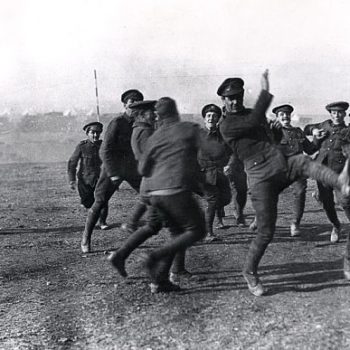
The Christmas Truce of 1914 is one of the most extraordinary episodes in the history of modern warfare. Along the frozen, muddy trenches of the Western Front, British and German soldiers laid down their arms, stepped into No Man’s Land, and embraced a moment of shared humanity. They exchanged food and souvenirs, sang carols together, and, according to legend, played football. But did they really?
At first glance, the idea seems improbable. The conditions in the trenches were horrific. Even if opposing sides could momentarily set aside their differences, how likely is it that they had access to a ball, boots suited to the game, or enough flat land free of shell craters and human remains?
And yet, accounts from the time suggest that at least one football game—or something resembling one—may well have taken place.

Fragments from the Front
Many soldiers wrote home about the Christmas Truce. A number of letters mention football, but few provide a clear, firsthand description. Some seem to be repeating rumours, while others are vague about who played and where.
Take this letter, for example, reported in the Bolton Chronicle on 2 January 1915. A local postal worker, Mr J. A. Farrell, shared a letter from the front:
“In the afternoon there was a football match played beyond the trenches, right in full view of the enemy.”
It’s unclear whether this was a match between Allied troops only or whether the Germans took part. Was this simply a game staged behind the lines? The wording leaves room for doubt.
Another letter, published in the Rugby Advertiser on 16 January 1915, recounts the following:
“They wanted to play at football but that fell through. They kept their word, and did not fire a shot all Christmas Day and Boxing Day.”
This suggests good intentions, but also highlights that not all attempts at sport succeeded—sometimes due to a lack of equipment or interference from higher command.
The Mysterious 3–2 Scoreline
The most famous contemporary reference to a match comes from The Times, dated 1 January 1915. An anonymous British major is quoted:
“The … (censored) Regiment actually had a football match with the Saxons, who beat them 3–2.”
This is often cited as the primary evidence for an organized game. But was the major reporting a fact he witnessed, or simply passing on hearsay? Even historians are divided. Malcolm Brown and Shirley Seaton, authors of Christmas Truce (1984), note that a German account also mentions a match with a 3–2 score, but in a different location. They write:
“The fact two scores of 3–2 occur in the accounts of Christmas Day football must be assigned either to a curious coincidence or to mistaken memory. The two matches referred to could not have been the same one; in that the units concerned were separated not only by geographical distance but also by the river Lys.”
Ernie Williams and a Firsthand Account
In 1983, former soldier Ernie Williams, who served with the 6th Battalion of the Cheshire Regiment, gave a television interview in which he described taking part in a football match himself. His words are among the most detailed personal accounts of the event:
“The ball appeared from somewhere, I don’t know where, but it came from their side – it wasn’t from our side that the ball came. They made up some goals and one fellow went in goal and then it was just a general kickabout. I should think there were about a couple of hundred taking part. I had a go at the ball. I was pretty good then, at 19. Everybody seemed to be enjoying themselves. There was no sort of ill-will between us. There was no referee, and no score, no tally at all. It was simply a melee – nothing like the soccer you see on television. The boots we wore were a menace – those great big boots we had on – and in those days the balls were made of leather and they soon got very soggy.”
Williams had been stationed at Wulverghem (just north of Ploegsteert, Belgium), where No Man’s Land was relatively intact and free of shell damage—making it one of the few places where such a kickabout could have happened.
Supporting Testimony: Frank Naden
Another account comes from Company Sergeant Major Frank Naden, also of the 6th Cheshires, who spoke to the Evening Mail in Newcastle just days after the truce. He said:
“On Christmas Day one of the Germans came out of the trenches and held his hands up. Our fellows immediately got out of theirs, and we met in the middle, and for the rest of the day we fraternised, exchanging food, cigarettes and souvenirs. The Germans gave us some of their sausages, and we gave them some of our stuff. The Scotsmen started the bagpipes and we had a rare old jollification, which included football in which the Germans took part. The Germans expressed themselves as being tired of the war and wished it was over… The next day we got an order that all communication and friendly intercourse with the enemy must cease, but we did not fire at all that day, and the Germans did not fire at us.”
Naden’s testimony, given so soon after the events, offers some of the most compelling support for Williams’s later recollection. Together, their stories point strongly toward a kickabout happening at Wulverghem, with both sides involved.
So, Did It Really Happen?
While the evidence is not definitive, it is persuasive. There may not have been a formal 11-a-side football match with goalposts and referees, but the idea of an informal kickabout shared between enemies is supported by multiple sources—some contemporary, some recalled later in life. If a ball was present and men kicked it around, laughed, and found common ground through sport, that alone speaks volumes.
It’s also quite possible that similar games occurred in other sectors, though they went undocumented or were quickly suppressed. Commanders on both sides were alarmed by the fraternization and ensured it would not happen again.
Over time, the football match has become a powerful symbol—of peace, humanity, and the hope that even in war, there can be moments of understanding. And perhaps that symbolic truth matters just as much as historical certainty.