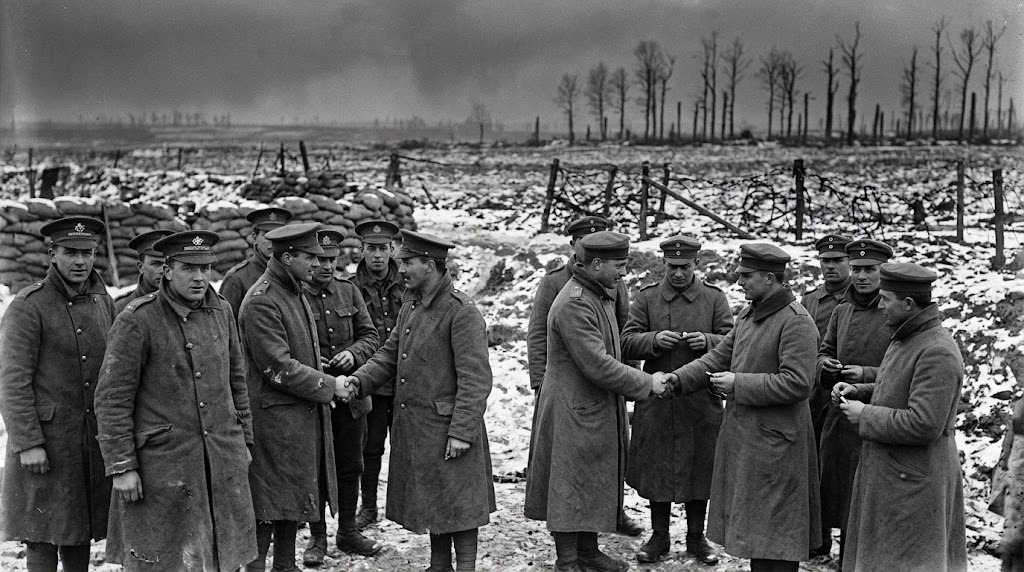
Among the territorial battalions of the British Expeditionary Force (BEF) that participated in the unofficial ceasefires of December 1914, the 1st Battalion, Hertfordshire Regiment left some of the most vivid and historically important records. Holding the frontline trenches at the southern edge of Ploegsteert Wood near Saint-Yvon, the “Herts” (part of the 4th Guards Brigade, 2nd Division) were heavily involved in the spontaneous truce. The Hertfordshire Regiment 1914 Christmas Truce letters—sent back to families and printed in local newspapers like the Hertfordshire Mercury in January 1915—document the remarkable transformation of a muddy, freezing battlefield into a place of shared humanity.
The Frontline at Saint-Yvon in December 1914
By mid-December 1914, the 1st Battalion, Hertfordshire Regiment had taken up positions in the waterlogged Saint-Yvon sector, situated in a low-lying valley between the British-held Ploegsteert Wood and the German-occupied Warneton. The ground was in a deplorable state, with trenches frequently collapsing from heavy rain and a high water table. Opposing them were the Saxon troops of the 134th Royal Saxon Infantry Regiment, who were located within easy shouting distance—in some places less than one hundred yards away.
When the temperature plummeted on Christmas Eve, freezing the mud, the environment grew silent. The Herts watched as candle-lit Christmas trees (Tannenbäume) were placed on the German parapets, and they heard the enemy begin to sing. By the morning of 25 December, both sides had ventured into No Man’s Land without weapons, initiating an informal truce that lasted until the day after Boxing Day.
A famous incident in this sector involves Captain (then Lieutenant) Clifton Stockwell of the Royal Welch Fusiliers and officers from the 1st Hertfordshire, who met German Saxon officers to negotiate the truce terms. In a spirited gesture of cooperation, the British forces even exchanged a barrel of beer for the Germans’ promise to hold fire—and they agreed on warning signals to mark the resumption of hostilities.
For a detailed breakdown of how this sector fit into the broader Western Front ceasefires, examine our 1914 Christmas Truce overview.
“Like a Bank Holiday”: Firsthand Letters from the Saint-Yvon Trenches
Because local newspapers in Hertfordshire printed many of these letters home, they bypassed the heavier military censorship that would eventually restrict descriptions of the truce. In a letter printed in the Hertfordshire Mercury in early January 1915, one Herts soldier wrote:
“It was a truly marvelous sight. Christmas Day was like a Bank Holiday. The Germans came out of their trenches, and we went out of ours, and we met halfway. They were really very friendly, and we exchanged cigarettes, buttons, and cap badges. They were Saxon troops, and many of them spoke good English. We were out there in No Man’s Land for hours, just talking and shaking hands. You wouldn’t have believed we’d been trying to kill each other just the day before.”
Another account, written by a Corporal from the 1st Herts, focused on the shared task of burying the fallen, which took place in the frozen open spaces:
“We helped them bury their dead, and they helped us with ours. It was a very sad but peaceful service, with officers and men from both sides standing together, heads uncovered. It felt almost like a dream. Afterward, we traded some of our bully beef and chocolate for their cigars and sausages.”
These letters, written directly by the men on the scene, are indispensable for historians. You can read more accounts of this kind in our Christmas Truce 1914 eyewitness letters archive and our examination of how the Christmas Truce felt to the men who lived it.
Historical and Educational Value
The letters of the 1st Battalion, Hertfordshire Regiment remain highly prized by the Operation Plum Pudding archive. Unlike memoirs written decades after the war, these letters reflect the immediate, unfiltered thoughts of territorial soldiers. Cross-referencing these accounts with the official Battalion War Diary (The National Archives, WO 95/1342) confirms the quietness of the Saint-Yvon sector on 25 and 26 December, highlighting “no casualties” and the casual encounters that took place.
The historical records of the Herts continue to be cited by educators, authors, and projects like Operation Plum Pudding, serving as a powerful reminder of the human connections that briefly flourished in the trenches of Flanders.