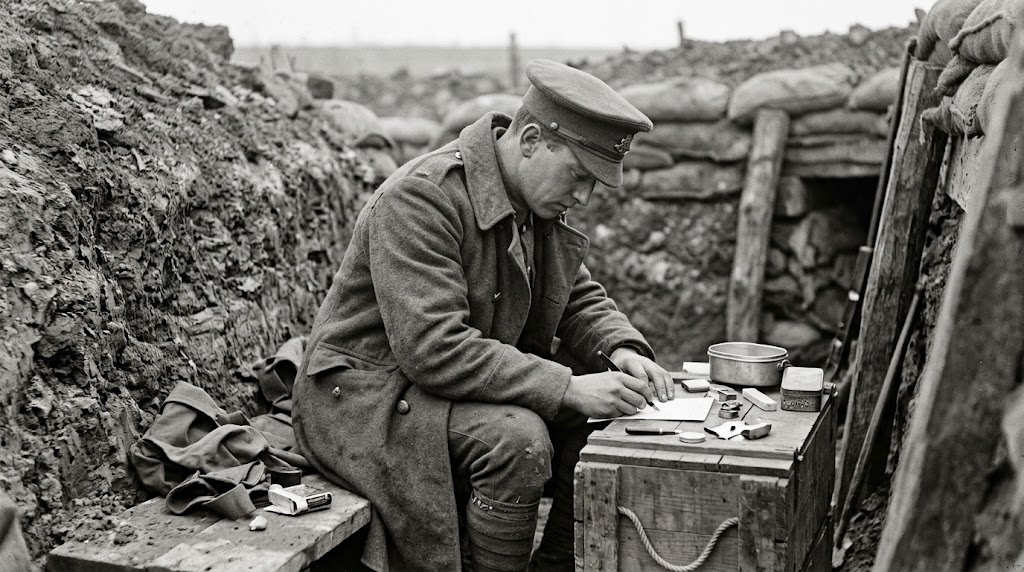
Among the hundreds of personal letters dispatched from the Western Front during the final week of December 1914, the account written home by a British soldier named Private Heath stands as one of the most widely cited primary testimonies of the First World War. Preserved through early 1915 British newspaper printings and archival collections, Private Heath’s 1914 Christmas Truce letter captured the immediate moral and sensory shock felt by ordinary infantrymen when opposing trenches fell silent on Christmas Eve and enemies met unarmed in No Man’s Land.
Historical Context: Writing Home from the Frontline Trenches
By late December 1914, British Expeditionary Force (BEF) battalions holding the waterlogged clay line across French Flanders and southern Belgium had endured nearly four months of continuous attrition following the Battle of the Aisne and the First Battle of Ypres. Soldiers lived in shallow, sandbagged breastworks exposed to freezing rain, sniper fire, and artillery shrapnel, separated from German trenches by strips of cratered farmland often narrower than one hundred yards.
When a sharp overnight frost hardened the mud on 24 December 1914, German soldiers along multiple sectors placed candle-lit fir trees (Tannenbäume) on their parapets and began singing Christmas carols. Writing to his mother shortly after the ceasefire, Private Heath recorded the extraordinary transition from lethal trench vigilance to open-air camaraderie—expressing amazement that men who had been trying to kill one another twenty-four hours earlier were suddenly shaking hands and sharing tobacco between the wire.
Key Themes Preserved in Private Heath’s Account
Historians and major publications—including Smithsonian Magazine—have repeatedly referenced Heath’s correspondence because it distils the core human realities of the December 1914 armistice without political embellishment:
- Spontaneous Cessation of Hostilities: Heath described how rifle and artillery fire died away on Christmas Eve as singing echoed across No Man’s Land, replacing the constant acoustic strain of trench warfare with an eerie, peaceful silence.
- Face-to-Face Encounters Between the Lines: On Christmas morning, British and German soldiers climbed above their sandbag parapets in full daylight, meeting halfway across the frozen ground to shake hands, exchange seasonal greetings, and converse in broken English and German.
- Ration and Souvenir Exchanges: Like fellow infantrymen in the Hampshire Regiment and the 2nd Battalion, Border Regiment, Heath noted the immediate swapping of British cigarettes, bully beef, and tunic buttons for German cigars and mementoes.
- Awareness of the Truce’s Fragility: Beneath the warmth of the encounter, Heath’s letter conveyed the sobering recognition that the ceasefire was purely an informal soldier-led pause—and that orders from High Command would soon compel both sides to return to their trenches and resume fighting.
Archival Verification Within the Operation Plum Pudding Collection
Within the Operation Plum Pudding archive, individual letters such as Private Heath’s are evaluated alongside regimental war diaries (The National Archives, WO 95 series) and provincial January 1915 newspaper files. Because national press censorship tightened rapidly in mid-January 1915 under the Defence of the Realm Act, letters forwarded by mothers and families to local editors preserved candid reflections that official military histories later omitted.
Comparing Heath’s narrative with contemporary dispatches from Ploegsteert Wood, Rouges Bancs, and Frelinghien confirms a consistent pattern across the British sector: ordinary infantrymen harboured no personal hatred toward the men facing them across the wire, viewing the Christmas ceasefire as a brief reclamation of civilian humanity amidst industrial warfare.
Explore Related Primary Accounts
To examine additional soldier correspondence from Christmas week 1914, explore our Christmas Truce 1914 eyewitness letters archive, our analysis of how the Christmas Truce felt to the men who lived it, and our chronological 1914 Christmas Truce overview.